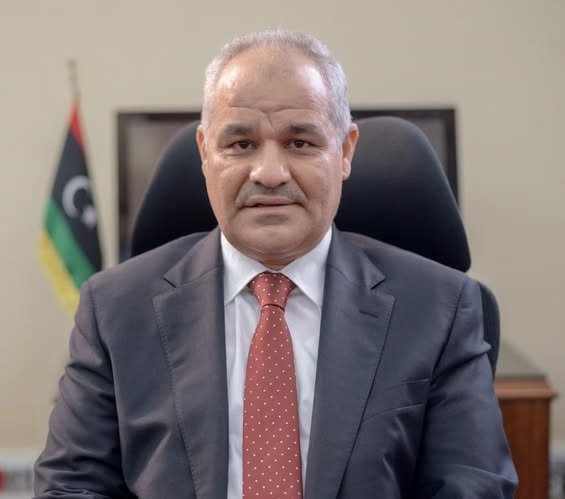

Libya’s Central Bank Governor Naji Issa has submitted his resignation, adding fresh uncertainty to the country’s fragile financial and political situation. Issa confirmed the resignation, but said the reasons were too sensitive to disclose. His resignation letters were submitted to both rival legislative bodies, according to documents seen by Reuters. Issa was appointed in 2024 following a UN-backed agreement between Libya’s rival political factions to resolve a dispute over control of the Central Bank. His appointment helped ease a crisis that had threatened the country’s oil exports and financial stability. The dispute erupted after western authorities moved against longtime central bank governor Sadiq al-Kabir in August 2024.
The move prompted authorities in eastern Libya to halt oil production and exports, cutting national output by roughly half to about 600,000 barrels per day, according to Libya’s National Oil Corporation. Libya remains politically divided between the UN-recognised government in Tripoli, led by Prime Minister Abdulhamid Dbeibah, and an eastern-based administration backed by military commander Khalifa Haftar. The Central Bank is particularly important because Libya depends heavily on oil revenues, while much of the country’s oil production is located in areas controlled by forces aligned with Haftar. The bank also plays a central role in managing the country’s foreign currency, public finances and monetary policy.
Following Issa’s announcement, High Council of State President Mohamed Takala urged him to remain temporarily in office to help preserve financial and political stability. Libya’s eastern-based House of Representatives had not immediately issued a response. Issa’s departure could therefore reopen questions over the leadership and independence of Libya’s central financial institution, at a time when the country remains divided and continues to struggle with competing political and economic interests.