
The Economic Community of West African States (ECOWAS) has reaffirmed its commitment to launching the long-awaited ECO single currency in 2027, with leaders signaling that the common currency will likely be introduced in phases rather than simultaneously across all member states. The decision was announced in a communiqué issued after the ECOWAS Heads of State and Government Summit held in Freetown, Sierra Leone, where regional leaders reviewed progress on monetary integration and economic cooperation. Under the proposed approach, only countries that meet agreed macroeconomic convergence criteria, including targets for inflation, public debt, fiscal deficits, foreign reserves and monetary stability will participate in the first phase of the currency’s rollout. ECOWAS says the ECO is intended to strengthen regional economic integration, facilitate cross-border trade, reduce transaction costs, enhance financial stability and support sustainable and inclusive economic growth across West Africa. Leaders welcomed the legal registration of the ECO trademark as an important milestone in the project. However, several critical issues remain unresolved before the currency can be introduced.
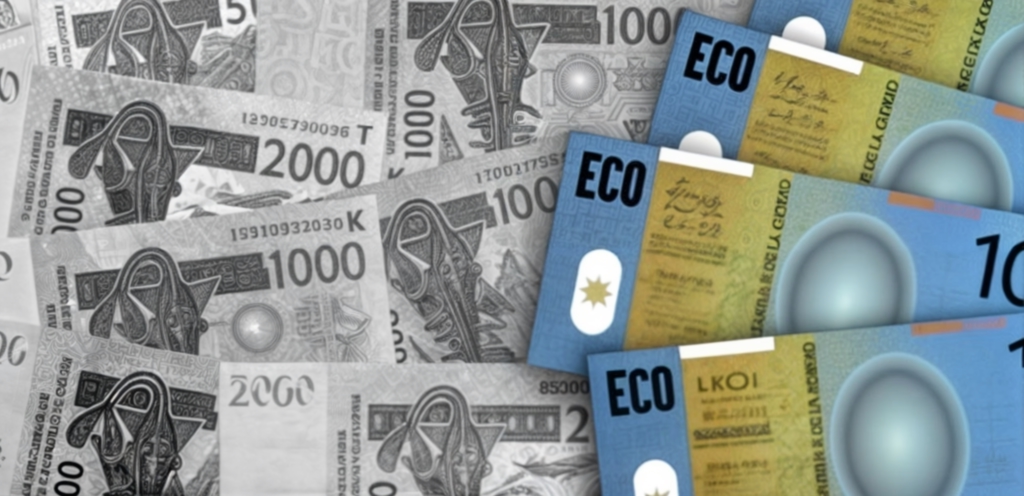
Among the outstanding questions are the structure and governance of the proposed ECOWAS Central Bank, decision-making arrangements, the exchange rate regime and which countries will qualify to adopt the currency at launch. Another key issue is the participation of members of the West African Economic and Monetary Union (UEMOA), whose eight countries currently use the CFA franc, a currency backed by the French Treasury. ECOWAS has yet to determine whether those countries will join the ECO from the outset or transition at a later stage. The project also faces new political challenges following the withdrawal of Burkina Faso, Mali and Niger from ECOWAS. Although the three countries have exited the regional bloc, they remain members of UEMOA, adding complexity to plans for a unified West African currency.
ECOWAS said consultations among finance ministers, central bank governors and technical experts are continuing, with a high-level ECO Task Force expected to meet before the bloc’s December 2026 Summit to finalize outstanding policy and institutional issues. The ECO has been under discussion for more than two decades as part of ECOWAS’ broader vision of creating a fully integrated regional market. Regional leaders believe its successful implementation could boost investment, strengthen intra-African trade under the African Continental Free Trade Area (AfCFTA) and enhance the region’s economic resilience. Despite repeated delays, ECOWAS says it remains committed to delivering the single currency, while emphasizing that economic stability and institutional readiness will determine the pace of implementation.