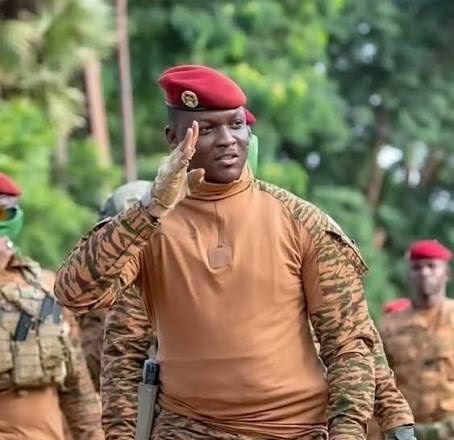

Burkina Faso’s military leader, Captain Ibrahim Traoré, is marking four years in power, renewing comparisons with revolutionary leader Thomas Sankara, who governed the country for roughly the same period before his assassination in 1987. Both came to power as young army captains and promoted national sovereignty, Pan-Africanism and greater economic self-reliance. Sankara’s 1983–1987 government focused on education, healthcare, women’s empowerment, local production and reducing dependence on foreign powers.
Traoré, who seized power in a 2022 coup, has adopted similar themes. His government has increased state control over gold resources, promoted local industries and launched Faso Mêbo, an infrastructure program focused on roads and urban development using local resources. Burkina Faso also inaugurated its first gold refinery in September 2026, with an initial annual capacity of 164 tones. The security environment, however, is markedly different. Burkina Faso continues to face attacks by jihadist groups, particularly in northern areas, with some communities experiencing prolonged insecurity and blockades. Independent assessments have recorded a sharp increase in conflict-related deaths since Traoré took power.
Traoré’s government has also faced criticism over restrictions on political activity and civil liberties. Journalists, opposition figures, magistrates and civil-society activists have reportedly been forcibly recruited for military service or deployed to conflict areas. Diplomatically, Traoré has moved Burkina Faso away from France and strengthened ties with Russia. Alongside Mali and Niger, Burkina Faso left ECOWAS and established the Alliance of Sahel States (AES), reflecting the three governments’ push for greater regional and political autonomy. While Traoré continues to invoke Sankara’s legacy, analysts note that the two periods differ sharply in their security conditions, political systems and international alignments. The comparison remains central to how Traoré presents his government’s vision of sovereignty and economic independence.