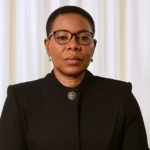
The High Military Court in Kinshasa will deliver its verdict on Friday in the landmark war crimes trial of former Democratic Republic of Congo (DRC) President Joseph Kabila, after delaying the ruling to admit new evidence allegedly linking him to the Rwanda-backed M23 rebel movement. The one-week adjournment, announced last Friday, followed prosecutors’ request for time to assess fresh financial records and witness testimonies. According to state lawyers, the material directly traces funds from Kabila’s network to the M23 group, which has been accused of atrocities in eastern Congo. Judges ruled the evidence admissible, making this trial one of the most consequential in the nation’s post-independence history.
Kabila, who ruled the DRC for 18 years until 2019, faces charges of treason, complicity with M23, crimes against humanity, rape, murder, and large scale corruption. Prosecutors have urged the court to impose the death penalty. A controversial element of the case includes claims that Kabila holds Rwandan nationality, with lawyers pushing to reclassify treason as espionage. The former leader, currently in exile and tried in absentia, has denounced the proceedings as a “politically motivated witch hunt” led by his successor, President Félix Tshisekedi. In a recent YouTube statement, he insisted: “This trial has nothing to do with justice.” His allies argue the case is designed to silence a powerful political rival.
Tshisekedi’s government has already revoked Kabila’s immunity, dissolved his political party, and seized assets allegedly tied to rebel controlled territories. The trial highlights the DRC’s deep political divisions and ongoing struggles with rebel violence in the east. A conviction could further destabilize the country, while an acquittal or perceived judicial weakness risks fueling mistrust in state institutions. International observers and human rights organizations are closely watching the case, describing it as a turning point that could either reinforce the rule of law or deepen Congo’s political crisis. The world now waits for Friday’s ruling, which may define the legacy of both Kabila and Tshisekedi’s government.