


A small collection of fossilized teeth unearthed in Ethiopia’s Afar region is reshaping our understanding of human origins. The fossils, discovered at the Ledi Geraru site just miles from where the famous 3.2 million year old “Lucy” skeleton was found are estimated to be between 2.6 and 2.8 million years old. Researchers say the teeth likely belonged to a previously unknown species of early human ancestor closely related to Australopithecus.
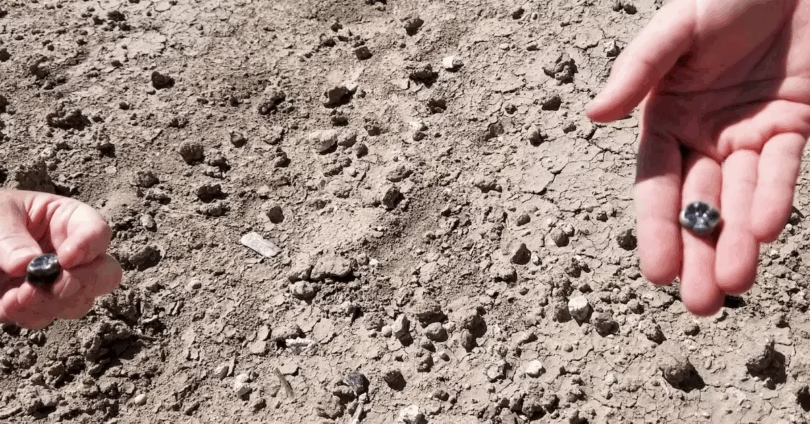
“This discovery shows there was far more diversity in the human lineage at this time than we previously believed,” said Amy Rector, a paleoanthropologist on the research team. Australopithecus, known for its ape-like features and ability to walk upright, is considered a crucial stepping stone in human evolution. But these fossils suggest that multiple species including early Homo and this unidentified ancestor may have coexisted. “It’s far more interesting if there are three or more species living at the same time, rather than a simple one-after-another progression,” Rector explained.
The discovery challenges the long-held view that human evolution was linear, instead pointing to a more complex and overlapping evolutionary process. While more fossil evidence is needed before the species can be formally named, scientists believe the find sheds critical light on a transitional period that eventually gave rise to Homo sapiens.


