
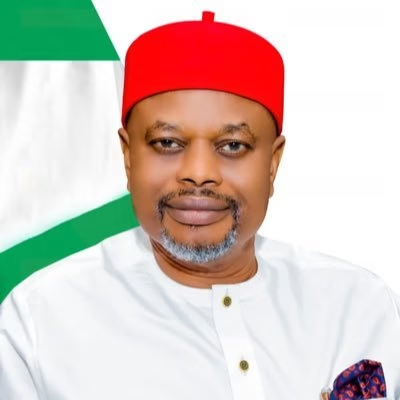

Nigeria’s Minister of Innovation, Science, and Technology, Uche Nnaji, has resigned following allegations that he forged his academic and national service credentials a scandal that has sparked widespread outrage and renewed debate about political accountability in Africa’s largest democracy. The resignation, confirmed late Tuesday by Presidential spokesperson Bayo Onanuga, came just days after an investigative report by Premium Times alleged that Nnaji submitted falsified academic documents during his 2023 ministerial vetting by President Bola Tinubu.
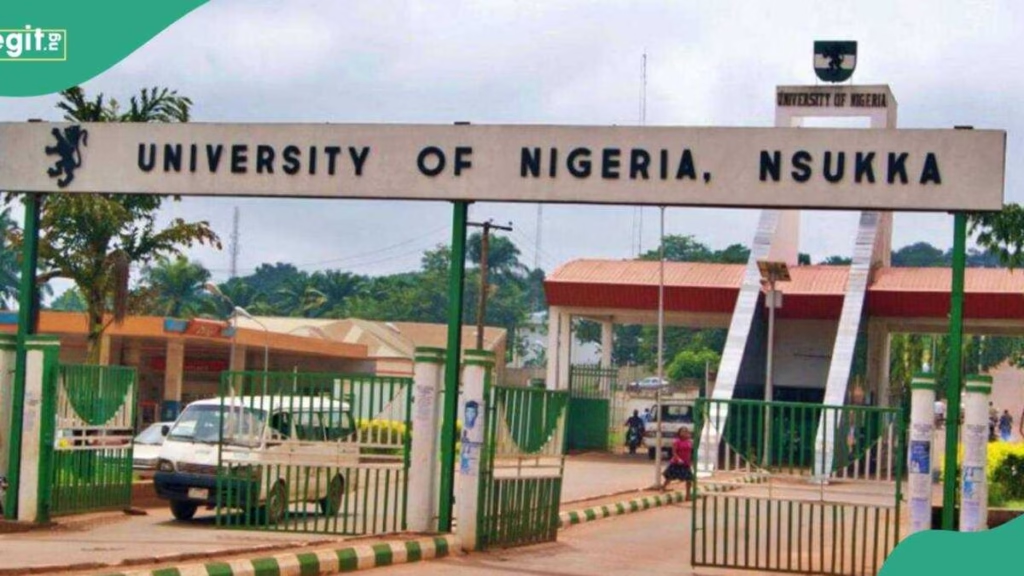
In a statement shared on X (formerly Twitter), Onanuga quoted Nnaji as saying he had become “a target of blackmail and political persecution.” The minister, however, denied any wrongdoing, insisting he earned a Bachelor of Science in Microbiology/Biochemistry from the University of Nigeria, Nsukka (UNN). But the Premium Times investigation, based on a two-year inquiry, claimed UNN officials could not find any record confirming that Nnaji completed his studies or graduated in 1985 as he asserted. A senior university source told reporters that while Nnaji enrolled in 1981, he “did not fulfill the requirements for graduation.”
Adding to the controversy, Nigeria’s National Youth Service Corps (NYSC) said the service certificate Nnaji submitted during his ministerial screening “could not be verified,” raising further doubts about his eligibility for public office. The scandal has drawn strong criticism from opposition figures and civil society. Atiku Abubakar, a former vice president and leading opposition figure, called for an independent investigation, saying, “Nnaji should have been summarily dismissed and prosecuted for deceit and falsification. Nigerians deserve honesty from those entrusted with power.”
The resignation marks a rare shake-up in President Tinubu’s cabinet. Nnaji becomes only the second minister to leave office since the administration began in May 2023. The first was Betta Edu, suspended earlier this year over alleged corruption in the Ministry of Humanitarian Affairs a case that is still under investigation. Analysts say the controversy could deal another blow to Tinubu’s government, already facing criticism over economic hardship and governance challenges. Transparency advocates have urged the presidency to strengthen background checks and verification processes for public appointees. If proven, the forgery allegations could lead to criminal charges under Nigeria’s Penal Code and Public Service Rules, both of which prescribe penalties for falsifying academic and national service credentials.


