Five years after toppling Mali’s elected government, the country’s military rulers remain firmly in power despite pledges to hand authority back to civilians within 18 months. The coup on August 18, 2020, ended Mali’s fragile democracy and set off a cycle of political upheaval. A transitional government led by Bah N’Daw was installed a month later, but he was soon ousted by Colonel Assimi Goïta, who remains in charge today.
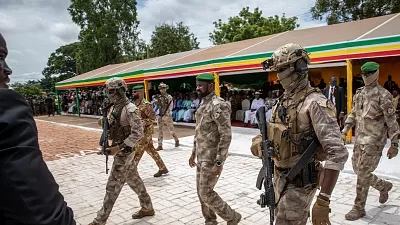
Goïta initially vowed to restore security and rid Mali of both jihadist insurgents and foreign troops. While French forces — once central to counterterrorism efforts — have withdrawn, they have been replaced by Russian paramilitary fighters, widely believed to be from the Wagner Group. Mali’s army, with Russian backing, retook the symbolic northeastern city of Kidal in late 2023. But rights groups say the victory was marred by reports of civilian abuses, and many areas remain under insurgent control with dozens of hostages still held.
Politically, Goïta has severed ties with the Economic Community of West African States (ECOWAS), which had pressed for elections. Instead, Mali has joined forces with fellow junta-led neighbors Niger and Burkina Faso to create the Alliance of Sahel States, a pact that envisions a future political federation and a deliberate weakening of French influence in the region. In its place, Bamako has deepened ties with Russia, Turkey, China, North Korea, and Iran, betting on new alliances to shore up its rule and reshape the Sahel’s geopolitical balance. But after five years, Mali’s promised return to democracy remains distant, while insecurity, rights abuses, and economic uncertainty continue to weigh heavily on ordinary citizens.